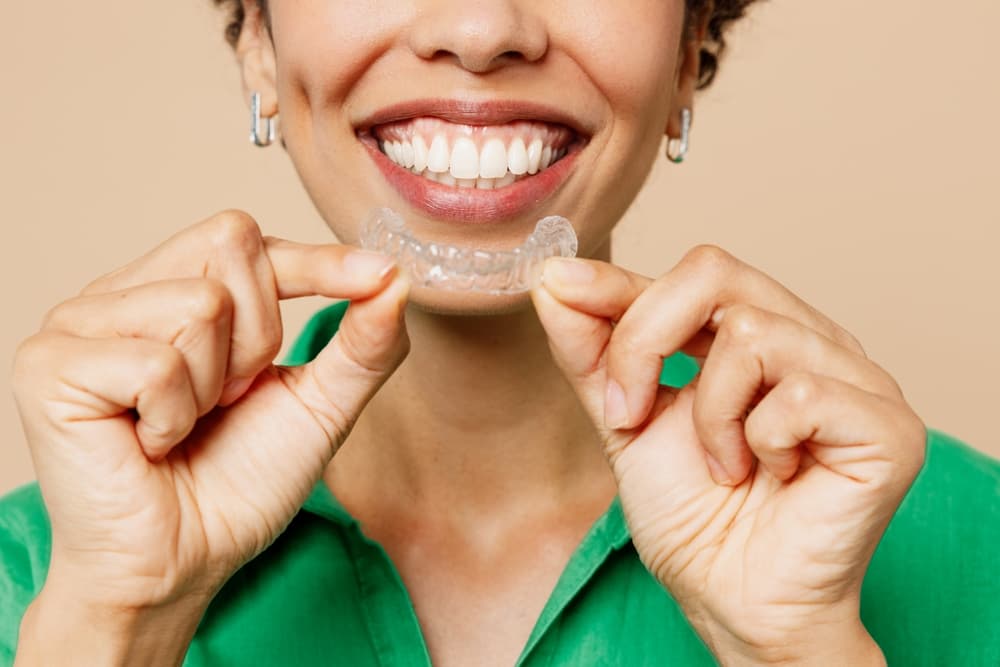
When people weigh up Invisalign vs braces today, they’re comparing modern Invisalign against a mental image of metal train tracks. What most of them don’t realise is that “modern Invisalign” is a completely different animal from the Invisalign I started using. I trained in it in 2005 — genuinely, long before it was mainstream — and I’ve watched it change almost beyond recognition. So if you’re trying to decide between aligners and braces, let me tell you what two decades of first-hand experience actually looks like.
I’ll be honest about the early days, because the contrast is the whole point.
When I first started with Invisalign, the material was completely different. The aligners were stiff and hard, and they were a genuine struggle to get in and out. Patients used to get ulceration from the edges. It worked — it straightened teeth — but it asked a lot of the person wearing it, and what we could actually treat with it was limited compared with today.
If that’s the version living in someone’s memory, I understand the hesitation. But it’s like judging a modern car by a model from twenty years ago.
The single biggest change is the material itself. Today’s aligners are what we call a trilaminate — three layers of plastic rather than one.
That structure does three jobs at once:
That’s why I’m so firm on this next line:
“It’s not just a piece of plastic.”
There is real engineering in a modern aligner. The force isn’t just “a tray squeezing your teeth” — it’s designed, layered and directed. At Smile Hub we invest heavily in training precisely because there’s so much to understand about how these movements are planned and delivered; the more you know about what’s going on inside that plastic, the better you can use it.
The material change isn’t just a technical curiosity — it translates directly into your experience:
That last point matters, and it’s where I want to be clear about my own role.
Modern aligners can tackle a wide range of movements, but that doesn’t mean they’re right for absolutely everyone, and it doesn’t make me something I’m not.
“I’m not saying I’m a specialist, but I’m a very experienced Invisalign provider, and if I felt that a specialist was required, we still refer.”
That’s a promise I take seriously. Being experienced means knowing when a case is well suited to aligners and recognising when someone would be better served by a specialist orthodontist or by fixed braces. Braces still have their place. The honest comparison isn’t “aligners always win” — it’s “which approach suits this particular mouth”, and part of my job is telling you when that answer isn’t me.
Another big shift is philosophy. We’ve learned to be more conservative about how we make room for teeth to move.
If teeth are crowded, we need to find space. One way is to gently widen the shape of the dental arch by moving teeth outward; another is to create tiny amounts of room between teeth, sometimes as little as 2mm, usually kept towards the back where it’s least visible. We’re guided by studies on where it’s safe to do this.
Because of that, Invisalign is typically a non-extraction treatment — we’re generally aiming to straighten teeth without removing any. I always caveat that every mouth is different and I’d never promise an outcome before assessing you, but the general direction of travel over twenty years has been towards keeping treatment as conservative as possible.
One of my favourite advances is what we can now show you before you commit. In the early days, the best I could offer was a static simulation — a picture of where your teeth might end up.
Now, with our Lumina scanner, I can show you a video of you — talking and smiling — with the projected result. Not a diagram of teeth on a screen, but your own face. Patients often walk in convinced only one tooth bothers them, and the simulation is what changes the conversation. It’s the closest thing to a live “before and after” I’ve ever had, and I lean on it in almost every consultation.
The way we monitor treatment has changed too, and City patients in particular appreciate this one.
When I first did Invisalign, I reviewed every patient in person every month — sometimes every four to six weeks. Now I typically see people roughly every three to four months, with photo check-ins in between through a system called Virtual Care, where patients submit photos around every two weeks. That means I can keep an eye on progress and troubleshoot early, without you having to take time out of work for an appointment that a photograph could have covered.
Shorter appointments, spaced further apart, with closer monitoring in between — that’s a genuine quality-of-life improvement over how it used to be.
This is the other question everyone asks, and I’ll answer it honestly: it depends entirely on your case. Some corrections are quick; others take considerably longer. To give you a sense of shape rather than a promise, a case might run something like ten months of active treatment followed by a final refinement stage — but please read that as illustrative only. The moment I’ve assessed your teeth I can give you a realistic estimate for you, and that’s the number that matters, not a general average.
Invisalign in 2026 is more comfortable, more predictable and capable of far more than the version I trained on. But my job hasn’t changed: assess honestly, treat what’s suitable for aligners, refer what isn’t, and be straight with you about time and expectations. The technology has come a very long way — and my commitment to using it responsibly hasn’t moved an inch.
Invisalign vs braces — which is better?
Neither is universally “better”. Modern aligners can handle a wide range of cases and are more discreet and comfortable, while fixed braces remain the right tool for certain complex movements. The best choice depends on your specific teeth and bite, which is what an assessment is for.
How long does Invisalign take?
It varies widely depending on how much movement is needed. Some cases are relatively quick; others take much longer. Any figure you read online is only illustrative — you’ll get a realistic estimate for your own case once your teeth have been assessed.
Does Invisalign require tooth extractions?
Invisalign is typically a non-extraction treatment. We usually create the small amounts of space needed by gently widening the arch or opening tiny gaps, often just a couple of millimetres. Every case is assessed individually, though.
How is modern Invisalign different from years ago?
The material is now a three-layer trilaminate that’s more comfortable and delivers engineered, directed force, so a wider range of cases can be treated more predictably. Monitoring has also moved largely to photo check-ins between longer-spaced appointments.
Wondering whether aligners or braces suit you? Book an Invisalign consultation at Smile Hub Spitalfields and we’ll assess your teeth honestly — including whether a specialist referral would serve you better.

Fill in the form and our friendly team will be in touch with you momentarily
I had a filling fall out over the weekend and I was so impressed with the efficiency at Smile Hub. I was able to get an appt the same day, and Dr.Kush and Evie took such great care at my appointment. ... Read More
I’m extremely happy with my Invisalign treatment and the final results! I honestly couldn’t recommend this practice more. Dr Kush completely transformed my smile and did an incredible job with my ... Read More
Dr Hena was absolutely the best in London!! She was incredible every step of the way throughout my appointments. Her warmth, care, and professionalism made me genuinely look forward to each visit. My ... Read More
I've seen many dentists across different countries over the years, and I can say without hesitation that Dr Hena Malkan is the best I've ever had. I saw her on several occasions for crown work, and th... Read More
I’ve just completed the Invisalign process with Dr. Hena and Kumari and I couldn’t be happier with the final result. From our initial consultation to the last check in, Dr. Hena was professional, ... Read More